
Pure Class Raphinha

Die neuesten Berichte

Real Betis 1-0 Getafe: Ezzalzouli strike, Soria stands tall
17. Sept. 2026
OFI Crete 2-0 Hoffenheim: Clinical finish, big saves
17. Sept. 2026
RB Salzburg beat Levski Sofia 1-0 in Europa League
17. Sept. 2026
Italy, Nearly 70 Pre-Selections for Mancini: Squad List Announced Tomorrow, Spotlight on a New Generation
17. Sept. 2026
Serie A has 14 players in the top 50, but only five are Italian
17. Sept. 2026
From Robbery to DiaLise: Can Bayern’s new wing duo create their own legacy?
17. Sept. 2026Pure Class Raphinha
In the ever-evolving landscape of modern European football, few positional transformations have been as rapid or devastating as Raphinha’s reinvention under Hansi Flick. Arriving at the Camp Nou in 2022 from Leeds United, the Brazilian was largely earmarked as a traditional, high-volume touchline winger—a player whose primary function was to stretch opposition low blocks, isolate full-backs in 1v1 scenarios, and deliver whipped crosses into the penalty box. While his initial two seasons yielded respectable double-digit goal and assist figures, they barely hinted at the sheer tactical versatility and scoring explosive power that lay dormant within his profile.
When Hansi Flick stepped into the Barcelona dugout, he recognized a rare tactical blend in Raphinha: an insatiable pressing engine, world-class off-the-ball movement, and an acute spatial awareness suited for the high-intensity, vertical mechanics of his system. Rather than locking him to the right touchline—where Lamine Yamal’s generational isolation abilities naturally dominate—this season Flick handed Raphinha the captain’s armband and gradually drifted him into central channels, effectively unleashing him as a hybrid “false nine” and dynamic interior operator. Underlying data tracking from Sofascore highlights how this positional shift has dramatically elevated his match ratings, establishing him as one of the most consistently high-performing attackers in European football. The results of this tactical shift have been nothing short of transformative. By operating centrally, Raphinha acts as both the tip of Barcelona’s pressing spear and their most lethal vertical outlet. His ability to initiate aggressive counter-pressing from the front forces opposition center-backs into rushed, central turnovers, while his diagonal runs into the half-spaces continually open up passing lanes for Barcelona’s creative midfield hubs.
Rather than diluting his influence, moving inside has amplified every metric in his game: his shot volume has surged, his conversion rate from high-probability Big Chances has reached elite efficiency, and his link-up play with wide runners like Yamal and Anthony Gordon keeps opposition defensive structures in a state of permanent tension. Raphinha is no longer just an explosive wide threat; he has established himself as the operational nerve center of Barcelona’s goalscoring engine.
The Reinvention of Barcelona’s High-Voltage Catalyst
Hansi Flick’s tactical machine continues to operate at a terrifying frequency, and their latest 7–2 demolition of Racing Santander provided yet another masterclass from the undisputed protagonist of Barcelona’s early-season dominance. Just six months after delivering a breathtaking hat-trick against Sevilla in a 5–2 victory that earned him a near-mythical 9.9 rating, the Brazilian forward replicated that goalscoring instinct. Operating as a relentless offensive engine before being withdrawn in the 69th minute for his compatriot Gabriel Jesus, Raphinha converted two penalties, created chaos in the half-spaces, and despite missing two Big Chances, walked off the pitch with a flawless 10 Sofascore Rating.
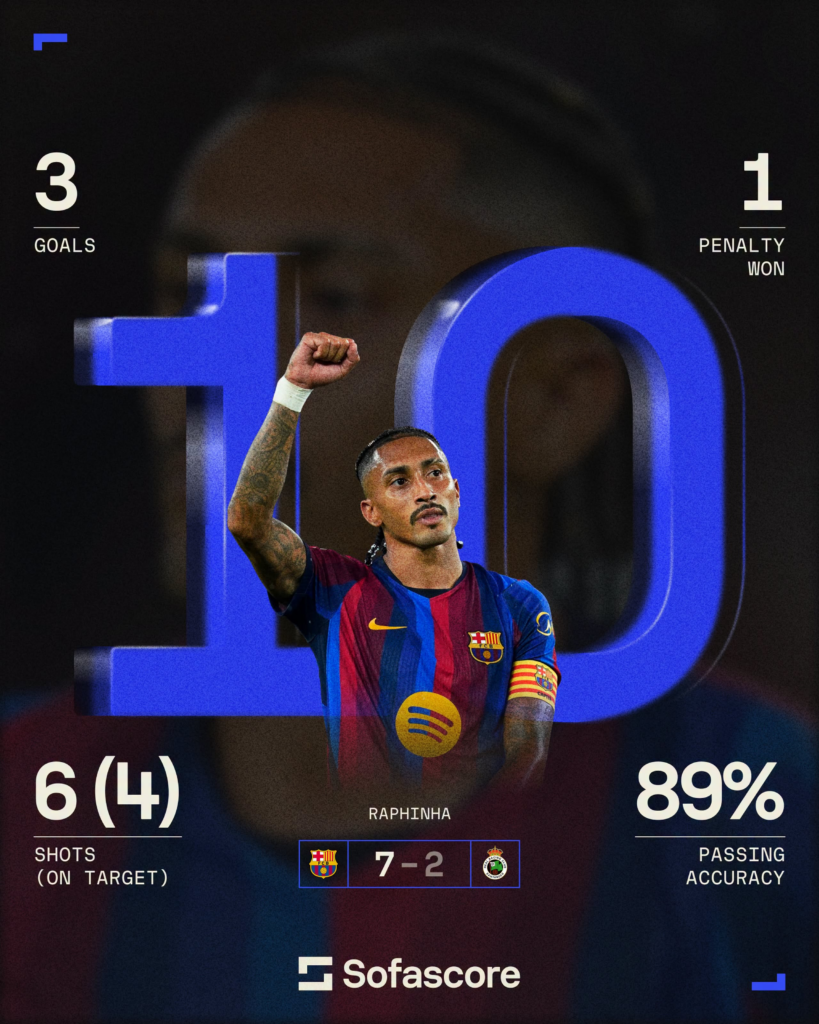
A deeper look at the underlying analytics reveals why his influence extends far beyond the scoresheet. Raphinha generated a massive 2.38 expected goals (xG), driven largely by his cool execution from the penalty spot. He registered 32 total touches, with 7 occurring directly inside the opposition penalty area—a metric highlighting his exceptional movement and positional instincts in the final third. Defensively and transitionally, he remained typically tireless, adding a successful dribble, two progressive carries, one tackle, and three ground duels won to complete a dominant all-round display.
Unsurprisingly, this performance earned him his fifth Fan Player of the Match award and his second Sofascore rating player of the match in just 7 official appearances this season—a clean sweep of individual recognition that reflects his standing among both analysts and supporters.
New Position, Same Raphinha
At the dawn of the campaign, Barcelona faced a tactical dilemma: a temporary absence of a traditional, physical central striker. Rather than altering his core tactical blueprint, Hansi Flick turned to the player who embodies his high-intensity pressing philosophy above all others, handing him the captain’s armband and entrusting him with the central attacking role. Raphinha responded by adapting to the central corridor as if he had spent his entire career operating between opposition center-backs.
Across just 549 minutes of action this season, Raphinha has logged an astonishing 11 goals and 3 assists. Yet, these primary output numbers merely scratch the surface of his underlying influence. Averaging 3.43 shots per match, he serves as a constant direct threat, while his 2.57 key passes per game repeatedly split opposition defensive lines, feeding wide runners like Lamine Yamal and Anthony Gordon. Remarkably, all 11 of his goals have stemmed from Big Chances, underlining both Barcelona’s incredible capacity to engineer high-probability opportunities for their new “false nine” and Raphinha’s clinical execution in front of goal.

Analyzing Raphinha’s match-by-match trajectory through Sofascore’s game log provides undeniable data-driven proof of his current status as Europe’s most lethal attacking force. Across seven official fixtures in the opening month of the campaign, the Brazilian forward has generated a staggering average match rating of 8.79, driven by an extraordinary concentration of elite individual masterclasses.
- Peak Rating Density: Out of seven matches, Raphinha has surpassed the near-mythical 9.5 rating threshold four separate times. His campaign opened with a breathtaking 9.9 rating performance against Elche (hat-trick plus an assist), followed by a 9.5 against Rayo Vallecano, a 9.8 in European action against Feyenoord, and capped off by a perfect 10.0 rating against Racing Santander.
- Goal Contribution Volume: Across these seven fixtures, Raphinha has accumulated 11 goals and 3 assists (14 direct goal contributions).
- Positional Consistency: Whether operating as a primary goalscorer (hat-tricks vs. Racing) or as a creator (2 assists vs. Levante), his baseline performance never dips below a 7.0 rating.
This level of output demonstrates that his transition into Hansi Flick’s central attacking hub is not merely a temporary hot streak, but an unsustainable level of tactical dominance that sets the benchmark for European football this season. Raphinha was never categorized as a pure penalty-box fox in the mold of Harry Kane, but his rapid scoring explosion—already surpassing his goal tally from his first two full seasons at the Camp Nou following his move from Leeds United—speaks volumes. He is currently pacing ahead of his career-defining 2024/25 campaign, where he notched an incredible 34 goals and 22 assists across all competitions.
Currently, no player across Europe’s top five leagues has surpassed the 10-goal threshold across all competitions this season. Given Barcelona’s current tactical momentum and Raphinha’s seamless mastery of his central role, the Brazilian isn’t just leading the line for Los Cules—he is firmly establishing himself as a primary contender for the next Ballon d’Or.

Raphinha’s Arrival at Football’s Apex
The data-driven evidence accumulated throughout the opening month of the 2026/27 campaign leaves little room for debate: Raphinha’s transition into Hansi Flick’s central attacking hub represents one of the most successful tactical adaptations in modern LaLiga history. By shifting the Brazilian from a traditional touchline winger into a high-intensity “false nine,” Barcelona has unlocked a player capable of blending ruthless penalty-box efficiency with relentless defensive pressing.
A staggering 8.79 Sofascore average rating, paired with 14 direct goal contributions in just 549 minutes of football, confirms that this is not a transient streak of good fortune, but a sustainable tactical baseline. Raphinha is no longer merely a complementary piece alongside generational talents like Lamine Yamal; wearing the captain’s armband, he has become the undisputed operational leader and tactical engine of this Barcelona side. If he maintains this unprecedented trajectory across domestic and European fronts, Raphinha will not only smash his career-high scoring records, but he will also stand as a frontrunner for the 2027 Ballon d’Or.
Raphinha’s Journey to the Summit
Born in Porto Alegre, Brazil, Raphael Dias Belloli, universally known as Raphinha, forged his gritty playing style on the varzea pitches of his hometown before joining Avaí’s youth academy. His European journey began in Portugal with Vitória Guimarães and Sporting CP, where his explosive pace and ball-striking ability quickly caught the attention of top European scouts. A successful stint at Rennes in Ligue 1 earned him a transfer to Leeds United in 2020. Under Marcelo Bielsa, Raphinha evolved into one of the Premier League’s most dynamic wingers, captivating fans with his relentless work rate and 1v1 dribbling.
In the summer of 2022, Raphinha achieved his dream transfer to FC Barcelona for a reported €58M fee. After establishing himself as a vital contributor in his first two seasons, his career reached new heights under Hansi Flick. Entrusted with the captain’s armband and transformed into a lethal central hybrid attacker, the Brazilian international has cemented his status as one of global football’s most impactful leaders and a primary contender for the sport’s highest individual honors.
 LaLiga

Die neuesten Berichte
Real Betis 1-0 Getafe: Ezzalzouli strike, Soria stands tall
17. Sept. 2026OFI Crete 2-0 Hoffenheim: Clinical finish, big saves
17. Sept. 2026RB Salzburg beat Levski Sofia 1-0 in Europa League
17. Sept. 2026Italy, Nearly 70 Pre-Selections for Mancini: Squad List Announced Tomorrow, Spotlight on a New Generation
17. Sept. 2026Serie A has 14 players in the top 50, but only five are Italian
17. Sept. 2026
In the ever-evolving landscape of modern European football, few positional transformations have been as rapid or devastating as Raphinha’s reinvention under Hansi Flick. Arriving at the Camp Nou in 2022 from Leeds United, the Brazilian was largely earmarked as a traditional, high-volume touchline winger—a player whose primary function was to stretch opposition low blocks, isolate full-backs in 1v1 scenarios, and deliver whipped crosses into the penalty box. While his initial two seasons yielded respectable double-digit goal and assist figures, they barely hinted at the sheer tactical versatility and scoring explosive power that lay dormant within his profile.
When Hansi Flick stepped into the Barcelona dugout, he recognized a rare tactical blend in Raphinha: an insatiable pressing engine, world-class off-the-ball movement, and an acute spatial awareness suited for the high-intensity, vertical mechanics of his system. Rather than locking him to the right touchline—where Lamine Yamal’s generational isolation abilities naturally dominate—this season Flick handed Raphinha the captain’s armband and gradually drifted him into central channels, effectively unleashing him as a hybrid “false nine” and dynamic interior operator. Underlying data tracking from Sofascore highlights how this positional shift has dramatically elevated his match ratings, establishing him as one of the most consistently high-performing attackers in European football. The results of this tactical shift have been nothing short of transformative. By operating centrally, Raphinha acts as both the tip of Barcelona’s pressing spear and their most lethal vertical outlet. His ability to initiate aggressive counter-pressing from the front forces opposition center-backs into rushed, central turnovers, while his diagonal runs into the half-spaces continually open up passing lanes for Barcelona’s creative midfield hubs.
Rather than diluting his influence, moving inside has amplified every metric in his game: his shot volume has surged, his conversion rate from high-probability Big Chances has reached elite efficiency, and his link-up play with wide runners like Yamal and Anthony Gordon keeps opposition defensive structures in a state of permanent tension. Raphinha is no longer just an explosive wide threat; he has established himself as the operational nerve center of Barcelona’s goalscoring engine.
The Reinvention of Barcelona’s High-Voltage Catalyst
Hansi Flick’s tactical machine continues to operate at a terrifying frequency, and their latest 7–2 demolition of Racing Santander provided yet another masterclass from the undisputed protagonist of Barcelona’s early-season dominance. Just six months after delivering a breathtaking hat-trick against Sevilla in a 5–2 victory that earned him a near-mythical 9.9 rating, the Brazilian forward replicated that goalscoring instinct. Operating as a relentless offensive engine before being withdrawn in the 69th minute for his compatriot Gabriel Jesus, Raphinha converted two penalties, created chaos in the half-spaces, and despite missing two Big Chances, walked off the pitch with a flawless 10 Sofascore Rating.
A deeper look at the underlying analytics reveals why his influence extends far beyond the scoresheet. Raphinha generated a massive 2.38 expected goals (xG), driven largely by his cool execution from the penalty spot. He registered 32 total touches, with 7 occurring directly inside the opposition penalty area—a metric highlighting his exceptional movement and positional instincts in the final third. Defensively and transitionally, he remained typically tireless, adding a successful dribble, two progressive carries, one tackle, and three ground duels won to complete a dominant all-round display.
Unsurprisingly, this performance earned him his fifth Fan Player of the Match award and his second Sofascore rating player of the match in just 7 official appearances this season—a clean sweep of individual recognition that reflects his standing among both analysts and supporters.
New Position, Same Raphinha
At the dawn of the campaign, Barcelona faced a tactical dilemma: a temporary absence of a traditional, physical central striker. Rather than altering his core tactical blueprint, Hansi Flick turned to the player who embodies his high-intensity pressing philosophy above all others, handing him the captain’s armband and entrusting him with the central attacking role. Raphinha responded by adapting to the central corridor as if he had spent his entire career operating between opposition center-backs.
Across just 549 minutes of action this season, Raphinha has logged an astonishing 11 goals and 3 assists. Yet, these primary output numbers merely scratch the surface of his underlying influence. Averaging 3.43 shots per match, he serves as a constant direct threat, while his 2.57 key passes per game repeatedly split opposition defensive lines, feeding wide runners like Lamine Yamal and Anthony Gordon. Remarkably, all 11 of his goals have stemmed from Big Chances, underlining both Barcelona’s incredible capacity to engineer high-probability opportunities for their new “false nine” and Raphinha’s clinical execution in front of goal.
Analyzing Raphinha’s match-by-match trajectory through Sofascore’s game log provides undeniable data-driven proof of his current status as Europe’s most lethal attacking force. Across seven official fixtures in the opening month of the campaign, the Brazilian forward has generated a staggering average match rating of 8.79, driven by an extraordinary concentration of elite individual masterclasses.
This level of output demonstrates that his transition into Hansi Flick’s central attacking hub is not merely a temporary hot streak, but an unsustainable level of tactical dominance that sets the benchmark for European football this season. Raphinha was never categorized as a pure penalty-box fox in the mold of Harry Kane, but his rapid scoring explosion—already surpassing his goal tally from his first two full seasons at the Camp Nou following his move from Leeds United—speaks volumes. He is currently pacing ahead of his career-defining 2024/25 campaign, where he notched an incredible 34 goals and 22 assists across all competitions.
Currently, no player across Europe’s top five leagues has surpassed the 10-goal threshold across all competitions this season. Given Barcelona’s current tactical momentum and Raphinha’s seamless mastery of his central role, the Brazilian isn’t just leading the line for Los Cules—he is firmly establishing himself as a primary contender for the next Ballon d’Or.
Raphinha’s Arrival at Football’s Apex
The data-driven evidence accumulated throughout the opening month of the 2026/27 campaign leaves little room for debate: Raphinha’s transition into Hansi Flick’s central attacking hub represents one of the most successful tactical adaptations in modern LaLiga history. By shifting the Brazilian from a traditional touchline winger into a high-intensity “false nine,” Barcelona has unlocked a player capable of blending ruthless penalty-box efficiency with relentless defensive pressing.
A staggering 8.79 Sofascore average rating, paired with 14 direct goal contributions in just 549 minutes of football, confirms that this is not a transient streak of good fortune, but a sustainable tactical baseline. Raphinha is no longer merely a complementary piece alongside generational talents like Lamine Yamal; wearing the captain’s armband, he has become the undisputed operational leader and tactical engine of this Barcelona side. If he maintains this unprecedented trajectory across domestic and European fronts, Raphinha will not only smash his career-high scoring records, but he will also stand as a frontrunner for the 2027 Ballon d’Or.
Raphinha’s Journey to the Summit
Born in Porto Alegre, Brazil, Raphael Dias Belloli, universally known as Raphinha, forged his gritty playing style on the varzea pitches of his hometown before joining Avaí’s youth academy. His European journey began in Portugal with Vitória Guimarães and Sporting CP, where his explosive pace and ball-striking ability quickly caught the attention of top European scouts. A successful stint at Rennes in Ligue 1 earned him a transfer to Leeds United in 2020. Under Marcelo Bielsa, Raphinha evolved into one of the Premier League’s most dynamic wingers, captivating fans with his relentless work rate and 1v1 dribbling.
In the summer of 2022, Raphinha achieved his dream transfer to FC Barcelona for a reported €58M fee. After establishing himself as a vital contributor in his first two seasons, his career reached new heights under Hansi Flick. Entrusted with the captain’s armband and transformed into a lethal central hybrid attacker, the Brazilian international has cemented his status as one of global football’s most impactful leaders and a primary contender for the sport’s highest individual honors.