
Long Ball Rodri

Nieuwste verhalen

Why are Inter, Roma and Como at the top of Serie A?
15 sep 2026
Premier League Team of the Week, Round 4: Brighton core leads a stacked XI
15 sep 2026
Freiburg are dreaming bigger: Could the Champions League be next?
15 sep 2026
Serie A Team of the Week, Round 4: hat-tricks, cameos and control
15 sep 2026
Ligue 1 Round 4 recap: PSG win at Brest, leaders keep pace
14 sep 2026
Bundesliga Round 3 recap: Bayern and Leipzig hit stride
14 sep 2026Long Ball Rodri
Few footballers in the history of the sport become so universally recognized that their name turns into an official blueprint for a position. Claude Makélélé defined “The Makélélé Role”—a destructive, discipline-heavy defensive anchor position that he refined to absolute perfection. When he departed Real Madrid for Chelsea, the Spanish giants felt an immediate structural void, spending years trying to plug the gap with exceptional talents who simply lacked that intangible “IT” factor.
Then there is the legendary Franz Beckenbauer, the quintessential libero. While the traditional sweeper role may have effectively vanished from modern tactical schemes, Beckenbauer redefined what a central defender could be. For younger fans or those unfamiliar with tactical history, the libero was far more than a last-ditch defender clearing danger; he was the primary playmaker who carried the ball out from deep, initiated attacking sequences, and dictated the exact pulse of his team. Even today, any ball-playing center-back with elite vision is inevitably compared to Beckenbauer, even if the pure sweeper role no longer exists. Add Filippo Inzaghi as the ultimate penalty-box “poacher” or Manuel Neuer as the prototype “Sweeper-Keeper,” and the list of positional trendsetters remains exclusive.
While German footballing innovations historically proved to be fertile ground for building out from the back, few nations have elevated the midfield pivot to an art form quite like Spain. This analysis isn’t about the traditional Makélélé-style destroyer. Instead, it focuses on the orchestrating pivot—the Rodri archetype. We examine how this role is evolving at Barcelona following Rodri’s major €60M summer arrival, drawing direct parallels to the players who occupied this sacred space before him. As always, deeper analytical metrics and underlying data can be explored on Sofascore.
Simply Rodri
It required no great leap of imagination to see how the reigning World and European champion—and former Ballon d’Or recipient—would seamlessly integrate into Barcelona’s setup. Barcelona hasn’t just utilized the “deep-lying playmaker” role over the decades; they practically patented it. The system demands a midfielder who operates in the engine room of the pitch, initiating attacking sequences through high-volume, short-passing combinations while possessing the physical capacity to cover ground defensively during opposition transitions.
Following his necessary rest period after the World Cup tournament on the North American continent, Rodri was inserted into the starting XI for three consecutive matches, offering an early tactical snapshot of his role in Catalonia. Across all three starting appearances, Rodri generated a Sofascore rating above 7.0 in each. However, a particularly impressive statistical anomaly occurred during Barcelona’s 4–2 victory over Levante, where Rodri registered a flawless 11 out of 11 completed long balls. The last time he logged an identical 11/11 long-ball performance was during his tenure at Manchester City in a high-intensity derby against Manchester United on March 2nd 2024.
A historical look into the data reveals a compelling trend: in the last 10 matches where Rodri posted a 100% long-ball completion rate (min. 10 attempts), his team walked away victorious 8 times, drawing once (against Shakhtar) and losing just once (a 1–2 defeat to Norway with Spain). In that international clash against Norway, Rodri completed a staggering 17 out of 17 long passes, ranking him third overall for single-match accurate long balls since the 2023/24 season.
Only Stefan Strandberg and Zeno Debast completed more in a single match (18/18 each). Crucially, both of those performances occurred in international qualifiers rather than top-five European leagues or major European club competitions. Furthermore, both Strandberg and Debast are central defenders—players who naturally enjoy the luxury of time and space to launch uncontested long passes forward, unlike a central midfielder operating under intense mid-block pressure.
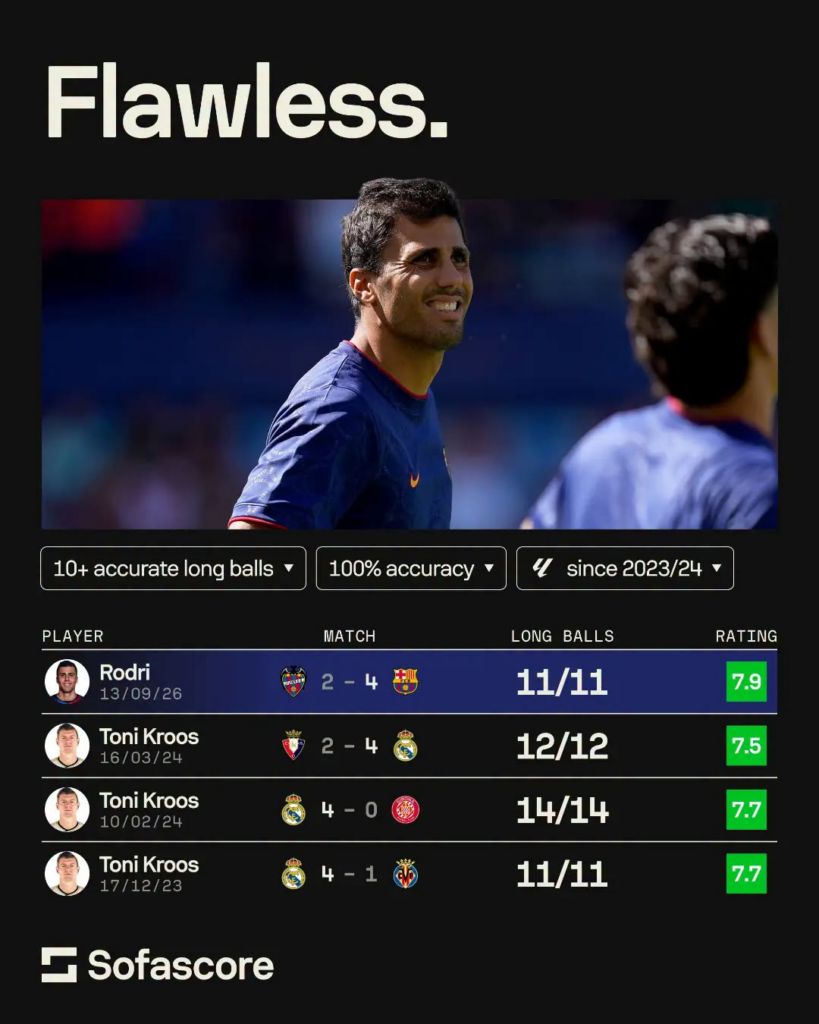
When analyzing elite distribution in Laliga football since the 2023/24 season, registering 10+ accurate long balls with a 100% completion rate is a statistical feat reserved for absolute masterminds. According to Sofascore metrics, Rodri’s recent performance against Levante (11/11 long balls, 7.9 rating) places him in an exclusive club previously dominated almost entirely by Real Madrid legend Toni Kroos.
Busquets, De Jong and the Passing of the Torch
The names associated with Barcelona’s midfield pivot carry immense historical weight. Sergio Busquets remains an absolute club legend—a master who spent over a decade resolving high-pressure situations with unbelievable calmness. Highlights of Busquets escaping tight traps deep in his own half via subtle body feints or one-touch wall passes continue to live rent-free in the minds of football purists. When Barcelona sought his long-term heir, they invested €86M to sign Frenkie de Jong from Ajax’s famed Champions League semifinalist generation. De Jong arrived as the dynamic, ball-carrying answer to the pivot role. However, recurring injury struggles repeatedly interrupted his continuity, preventing him from establishing an uninterrupted tactical rhythm over multiple seasons.
While comparing Rodri’s early metrics to Busquets and De Jong involves a small sample size of just five official appearances, the underlying metrics already indicate how his presence alters Barcelona’s dynamic. Rodri combines the structural discipline of Busquets with superior physical aerial dominance and a broader long-range passing distribution.

Debates may arise regarding whether his €60M price tag was steep for a player of his age profile. However, elite clubs pay for immediate execution. Rodri is currently at the absolute zenith of his physical, technical, and mental attributes. As the season unfolds, there is little doubt that the Spanish metronome will remain the central tactical subject of analysis across European football.
- Passing Efficiency & Ball Retention: Rodri stands out with a staggering 95.9% passing accuracy, outperforming both De Jong (92.4%) and Busquets (89.9%). This highlights Rodri’s extreme reliability in possession, minimizing high-risk turnovers in central areas.
- Progressive Play & Attacking Output: Frenkie de Jong leads the trio in offensive involvement, recording 20 goals and 29 assists alongside a top-tier 1.07 key passes and 19.3 final third passes per game. De Jong’s higher volume of forward passes and goal contributions highlights his inclination to drive forward into advanced zones.
- Defensive Workrate & Recovery Volume: Sergio Busquets remains the ultimate benchmark for ball-winning stability in the pivot position. Averaging 6.34 ball recoveries per game over 380 appearances (and 80 minutes per match), Busquets established a defensive baseline that both De Jong (4.73) and Rodri (4.20 in limited minutes) are aiming to replicate as structural rhythm develops.
As Rodri continues to integrate and build his minute volume, his near-flawless passing accuracy suggests he will offer unprecedented control in buildup phases, balancing Busquets’ defensive discipline with De Jong’s progressive distribution.
For how long Rodri vs. The Prime Years
Having entered the veteran stage of his professional career, Rodri still possesses 3 to 4 elite seasons at the absolute summit of world football. It will be fascinating to monitor both his tactical evolution within Barcelona’s system and the structural imprint he leaves on the squad in return. Barcelona’s summer strategy clearly signaled an intention to build a roster capable of conquering the UEFA Champions League, and a 3-to-4-year window with Rodri at his peak provides ample opportunity to establish a lasting legacy.
As Barcelona navigates a new tactical chapter, the integration of Rodri into the pivot role represents far more than a high-profile transfer—it is a deliberate evolution of the club’s positional identity. While replacing a legend of Sergio Busquets’ stature once seemed like an impossible task, and Frenkie de Jong’s dynamic ball-carrying offered a different profile, Rodri brings a rare fusion of elite physical resilience, tactical intelligence, and unprecedented passing reliability.
 LaLiga

Nieuwste verhalen
Why are Inter, Roma and Como at the top of Serie A?
15 sep 2026Premier League Team of the Week, Round 4: Brighton core leads a stacked XI
15 sep 2026Freiburg are dreaming bigger: Could the Champions League be next?
15 sep 2026Serie A Team of the Week, Round 4: hat-tricks, cameos and control
15 sep 2026Ligue 1 Round 4 recap: PSG win at Brest, leaders keep pace
14 sep 2026
Few footballers in the history of the sport become so universally recognized that their name turns into an official blueprint for a position. Claude Makélélé defined “The Makélélé Role”—a destructive, discipline-heavy defensive anchor position that he refined to absolute perfection. When he departed Real Madrid for Chelsea, the Spanish giants felt an immediate structural void, spending years trying to plug the gap with exceptional talents who simply lacked that intangible “IT” factor.
Then there is the legendary Franz Beckenbauer, the quintessential libero. While the traditional sweeper role may have effectively vanished from modern tactical schemes, Beckenbauer redefined what a central defender could be. For younger fans or those unfamiliar with tactical history, the libero was far more than a last-ditch defender clearing danger; he was the primary playmaker who carried the ball out from deep, initiated attacking sequences, and dictated the exact pulse of his team. Even today, any ball-playing center-back with elite vision is inevitably compared to Beckenbauer, even if the pure sweeper role no longer exists. Add Filippo Inzaghi as the ultimate penalty-box “poacher” or Manuel Neuer as the prototype “Sweeper-Keeper,” and the list of positional trendsetters remains exclusive.
While German footballing innovations historically proved to be fertile ground for building out from the back, few nations have elevated the midfield pivot to an art form quite like Spain. This analysis isn’t about the traditional Makélélé-style destroyer. Instead, it focuses on the orchestrating pivot—the Rodri archetype. We examine how this role is evolving at Barcelona following Rodri’s major €60M summer arrival, drawing direct parallels to the players who occupied this sacred space before him. As always, deeper analytical metrics and underlying data can be explored on Sofascore.
Simply Rodri
It required no great leap of imagination to see how the reigning World and European champion—and former Ballon d’Or recipient—would seamlessly integrate into Barcelona’s setup. Barcelona hasn’t just utilized the “deep-lying playmaker” role over the decades; they practically patented it. The system demands a midfielder who operates in the engine room of the pitch, initiating attacking sequences through high-volume, short-passing combinations while possessing the physical capacity to cover ground defensively during opposition transitions.
Following his necessary rest period after the World Cup tournament on the North American continent, Rodri was inserted into the starting XI for three consecutive matches, offering an early tactical snapshot of his role in Catalonia. Across all three starting appearances, Rodri generated a Sofascore rating above 7.0 in each. However, a particularly impressive statistical anomaly occurred during Barcelona’s 4–2 victory over Levante, where Rodri registered a flawless 11 out of 11 completed long balls. The last time he logged an identical 11/11 long-ball performance was during his tenure at Manchester City in a high-intensity derby against Manchester United on March 2nd 2024.
A historical look into the data reveals a compelling trend: in the last 10 matches where Rodri posted a 100% long-ball completion rate (min. 10 attempts), his team walked away victorious 8 times, drawing once (against Shakhtar) and losing just once (a 1–2 defeat to Norway with Spain). In that international clash against Norway, Rodri completed a staggering 17 out of 17 long passes, ranking him third overall for single-match accurate long balls since the 2023/24 season.
Only Stefan Strandberg and Zeno Debast completed more in a single match (18/18 each). Crucially, both of those performances occurred in international qualifiers rather than top-five European leagues or major European club competitions. Furthermore, both Strandberg and Debast are central defenders—players who naturally enjoy the luxury of time and space to launch uncontested long passes forward, unlike a central midfielder operating under intense mid-block pressure.
When analyzing elite distribution in Laliga football since the 2023/24 season, registering 10+ accurate long balls with a 100% completion rate is a statistical feat reserved for absolute masterminds. According to Sofascore metrics, Rodri’s recent performance against Levante (11/11 long balls, 7.9 rating) places him in an exclusive club previously dominated almost entirely by Real Madrid legend Toni Kroos.
Busquets, De Jong and the Passing of the Torch
The names associated with Barcelona’s midfield pivot carry immense historical weight. Sergio Busquets remains an absolute club legend—a master who spent over a decade resolving high-pressure situations with unbelievable calmness. Highlights of Busquets escaping tight traps deep in his own half via subtle body feints or one-touch wall passes continue to live rent-free in the minds of football purists. When Barcelona sought his long-term heir, they invested €86M to sign Frenkie de Jong from Ajax’s famed Champions League semifinalist generation. De Jong arrived as the dynamic, ball-carrying answer to the pivot role. However, recurring injury struggles repeatedly interrupted his continuity, preventing him from establishing an uninterrupted tactical rhythm over multiple seasons.
While comparing Rodri’s early metrics to Busquets and De Jong involves a small sample size of just five official appearances, the underlying metrics already indicate how his presence alters Barcelona’s dynamic. Rodri combines the structural discipline of Busquets with superior physical aerial dominance and a broader long-range passing distribution.
Debates may arise regarding whether his €60M price tag was steep for a player of his age profile. However, elite clubs pay for immediate execution. Rodri is currently at the absolute zenith of his physical, technical, and mental attributes. As the season unfolds, there is little doubt that the Spanish metronome will remain the central tactical subject of analysis across European football.
As Rodri continues to integrate and build his minute volume, his near-flawless passing accuracy suggests he will offer unprecedented control in buildup phases, balancing Busquets’ defensive discipline with De Jong’s progressive distribution.
For how long Rodri vs. The Prime Years
Having entered the veteran stage of his professional career, Rodri still possesses 3 to 4 elite seasons at the absolute summit of world football. It will be fascinating to monitor both his tactical evolution within Barcelona’s system and the structural imprint he leaves on the squad in return. Barcelona’s summer strategy clearly signaled an intention to build a roster capable of conquering the UEFA Champions League, and a 3-to-4-year window with Rodri at his peak provides ample opportunity to establish a lasting legacy.
As Barcelona navigates a new tactical chapter, the integration of Rodri into the pivot role represents far more than a high-profile transfer—it is a deliberate evolution of the club’s positional identity. While replacing a legend of Sergio Busquets’ stature once seemed like an impossible task, and Frenkie de Jong’s dynamic ball-carrying offered a different profile, Rodri brings a rare fusion of elite physical resilience, tactical intelligence, and unprecedented passing reliability.
The underlying Sofascore data clearly illustrates this shift: a staggering 95.9% passing accuracy and an impressive 7.20 initial average rating signal that the Spanish international is already dictating the tempo of matches with absolute authority. Possessing at least 3 prime seasons ahead of him, Rodri provides the structural foundation Hansi Flick’s side requires to mount a serious challenge for European glory. As the campaign progresses and his minutes increase, expect the Ballon d’Or winner to remain the central subject of statistical and tactical analysis, proving that Barcelona’s sacred midfield metronome is in safe hands for years to come.
The Rise of Spain’s Midfield Anchor
Born in Madrid, Rodrigo Hernández Cascante, universally known as Rodri, developed his tactical foundation in the youth academies of Rayo Majadahonda, Atlético Madrid, and Villarreal. He made his professional debut at Villarreal, where his exceptional positional discipline and ball recovery skills quickly established him as one of La Liga’s most promising defensive midfielders. A return to Atlético Madrid for the 2018/19 season refined his tactical versatility under Diego Simeone, prompting Manchester City to trigger his release clause in 2019.
Under Pep Guardiola, Rodri elevated his game to historic levels, becoming the ultimate metronome for City’s domestic and European dominance. He etched his name into club folklore by scoring the winning goal in the 2023 UEFA Champions League final. On the international stage, Rodri became the centerpiece of Spain’s national team, leading La Roja to victory at UEFA Euro 2024, where he was named Player of the Tournament. Recognized as the pinnacle of modern deep-lying playmakers, his career reached its individual zenith when he was awarded the prestigious Ballon d’Or in 2024.